
Respect the Game. Live the Standards.
Football is for everyone. Whether we play, coach, referee, volunteer, administer the game or support from the sideline, we all have a role in creating a safe, welcoming, respectful and enjoyable football community.
The Capital Football Behaviour Standards set clear expectations for how we treat each other, on and off the field, at training, on match day and online.
A shared standard for our game
These Behaviour Standards were developed collaboratively with clubs and other stakeholders over a series of engagement sessions. Through this process, we sought feedback on what is viewed as acceptable and unacceptable behaviour, how we want football in our region to be experienced and perceived, and how we can best support one another to address ongoing behavioural challenges.
The Behaviour Standards help everyone understand:
- how we treat each other
- what respectful behaviour looks like
- how we respond when people disagree
- how we protect the safety, dignity and wellbeing of participants
- how we uphold the integrity and reputation of football.
The Behaviour Standards are not simply something to refer to when behaviour falls short. They provide a positive and practical benchmark for the culture we want to see at every club, training session, match and football event.

The TEN Behaviour Standards
We all share responsibility for making football a place where everyone feels respected, safe, welcome and included. The following Behaviour Standards apply across every level of the game.
| 1 | Respect everyone We have respectful interactions with everyone in our football community and acknowledge the contribution of all our participants. |
| 2 | Promote respect and inclusion We promote a culture of respect and inclusivity, where every person is valued and treated with dignity. |
| 3 | Show positive passion We are passionate and enthusiastic about our teams and our sport. |
| 4 | Reject abuse and discrimination We do not accept any form of discrimination, harassment, bullying, abuse, intimidation, violence, offensive language or gestures, on or off the field, or on social media. |
| 5 | Respect referees We respect the referee’s decision, and we do not intimidate or abuse them before, during or after the game. |
| 6 | Play fairly We engage in fair play, give our best effort, show humility in success and grace in defeat. |
| 7 | Respect facilities and equipment We respect the grounds, equipment and property of our own facilities and our opponents. |
| 8 | Uphold the rules and integrity of football We understand and adhere to the rules of the game, upholding the reputation and integrity of football. |
| 9 | Accept responsibility We accept the consequences of our actions and decisions, and commit to doing better. |
| 10 | Hold each other accountable We hold each other to these Standards, speak out when we see poor behaviour, and support those who stand up to poor behaviour. |
Built together. Lived together.
We all share the responsibility to ensure that football is a place where everyone feels respected, safe, welcome and included.
This commitment extends across every level of the game.
Together, we commit to:
MODEL
Know, uphold and model the Behaviour Standards, while avoiding actions that could make others feel uncomfortable or unsafe.
LEAD
Lead by example in every interaction, on and off the field.
CREATE
Create environments that celebrate diversity and foster belonging.
INFLUENCE
Actively call out and address poor behaviour when we see it.
Small actions shape our culture
Respect is demonstrated through what we say, what we do and what we are prepared to accept. Every interaction contributes to the experience of players, referees, volunteers, coaches, families and supporters.
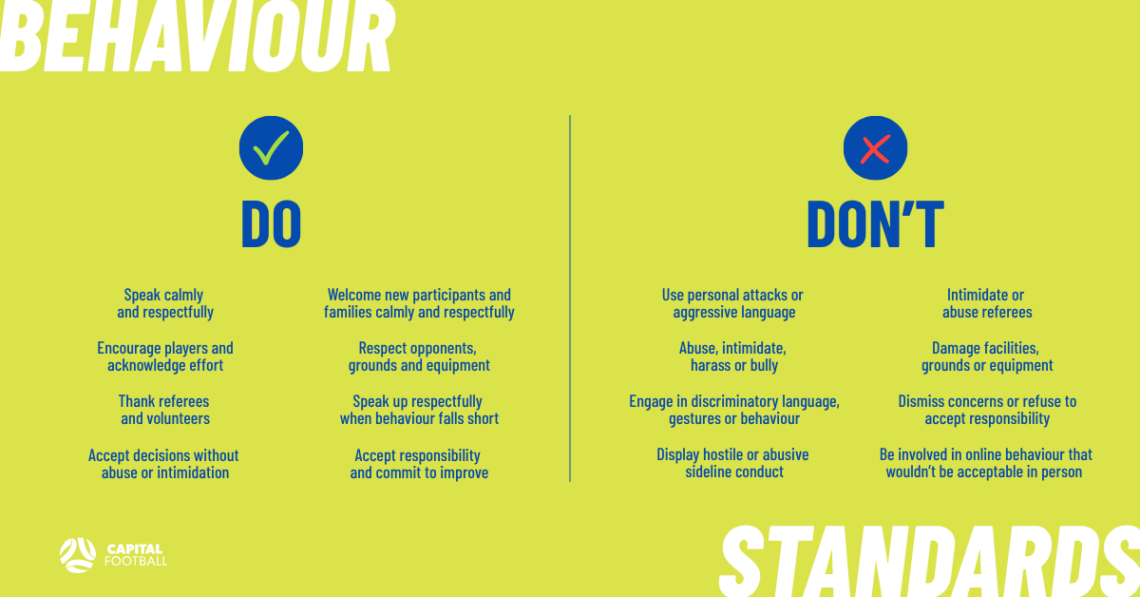
Everyone has a part to play
Players
Play fairly, respect teammates and opponents, listen to match officials and let your behaviour demonstrate your character.
Parents and spectators
Encourage effort, use positive language and remember that your voice helps set the culture on the sideline.
Coaches and team officials
Model the Standards, set clear expectations and reinforce respectful behaviour through training and match-day leadership.
Referees
Communicate respectfully, apply the Laws consistently and remain calm and professional, particularly in challenging situations.
Clubs and volunteers
Make the Standards visible, communicate them consistently, reinforce positive behaviour and support people to raise concerns appropriately.
Capital Football staff
Model professional and inclusive behaviour, provide consistent information and support clubs and participants to understand the Standards.
Helping clubs bring the Behaviour Standards to life
Clubs have a critical role in turning the Behaviour Standards into everyday practice. The Behaviour Standards should be visible and consistently reinforced at training, on match day, in meetings and events, and through online communication.
Ahead of the 2027 season, Capital Football will provide clubs with resources, communication materials and guidance to assist in incorporating the Behaviour Standards into club operations, member education and match day activities. We will work closely with clubs to ensure the Behaviour Standards understood, embraced and consistently applied across our football community.
Frequently asked questions
Why has Capital Football introduced Behaviour Standards?
The Behaviour Standards establish clear, shared expectations for behaviour and support a football environment that is safe, welcoming, respectful, inclusive and enjoyable for everyone involved.
Who do the BEHAVIOUR Standards apply to?
They apply across the football community, including players, coaches, referees, officials, volunteers, parents, guardians, spectators, club representatives and Capital Football.
Do the BEHAVIOUR Standards apply away from the field?
Yes. The Behaviour Standards cover behaviour on and off the field, including at training, meetings, football events and in online and social media environments.
Are the BEHAVIOUR Standards only about responding to poor behaviour?
No. The Behaviour Standards establish a positive benchmark for the culture we want to experience across football. They are intended to support education, positive reinforcement, shared responsibility and consistent expectations.
What should I do if I see behaviour that does not meet the Standards?
Where it is safe and appropriate, reinforce the expected behaviour respectfully and get in touch with the relevant club (in the first instance) or Capital Football channel to raise the concern. The Behaviour Standards supplement, not replace, any existing code of conduct or judicial processes.
What support is available to clubs?
Capital Football will provide clubs with practical resources ahead of the 2027 season, including communication materials and guidance to support incorporation of the Behaviour Standards into club operations, member education and match-day activities.
Will implementation happen immediately?
Building awareness is the first step. The implementation approach recognises that embedding the Behaviour Standards requires ongoing education, resources, club participation and reinforcement over time.
Find a club near you